• On July 21, 2020, the EU-27 reached a deal that covers the €750 billion Coronavirus recovery fund and the EU budget for 2021-2027. The €1.1 trillion EU budget will help define Europe’s relevance as a global power. But the slashing of spending on research and innovation gives reason to worry.

    As the US and China compete for power, Europe is losing ground

    A new Cold War is looming. This time the strife is between the United States and China as they are competing to become the world’s top power of the 21st century. One of the domains where this manifests itself is technological innovation. In key tech domains such as artificial intelligence, quantum computing, and robotics, Europe is being outpaced by the US and China. Fundamental sectors such as technology, manufacturing, and finance are increasingly dominated by American and Chinese firms. As Europe is losing ground, our norms, values, and prosperity are put at risk.

    A study by the McKinsey Global Institute (MGI) showed that European private investment in research and development (R&D) amounts to just 19% of the global total, versus 24% for China and 28% for the United States. Despite the fact that Europe has the largest public R&D spend, Europe produces only half as many patents per capita as the United States in digital, quantum computing, and big data.

    Europe needs to strengthen its position as a global power and can do so through better strategies to cultivate knowledge and innovation.

    Why knowledge leads to power

    The ultimate source of power is knowledge, as knowledge allows one to excel in more direct forces that lead to power, specifically economic force, military force, and political force. With these forces, one can exercise influence. With influence, one can protect and advance a society’s norms, values, prosperity, and ways of living.

    What follows is that the creation and cultivation of knowledge should be a strategic focus of any government. Key is that the strategies for the cultivation of knowledge are directed at two levels: the group and the individual.

    Strategies for cultivation of knowledge at the group level

    Knowledge is created through collaboration and interaction. This relates to the group level. To improve the cultivation of knowledge the EU needs to create stronger groups where collaboration and interaction take place. This brings us to the first strategy: the creation of EU Innovation Centers of Excellence (CoEs). For every strategic knowledge domain, the idea is to assign two to three European cities to build CoEs. It is important to have more than one CoE per domain, as this allows for healthy competition and reduces the risk of tunnel vision. It is equally important to limit the number of CoEs to about three in order to enable scale benefits. Pooling and concentrating funds allow the procurement of the most advanced (and often expensive) equipment. The selection of CoEs should be based on today’s relative strength in the knowledge domain and its future potential. There is an opportunity to tie two already strong cities (the ‘Stars’) to a third with great future potential (the ‘Rising Star’). The increased knowledge transfer from Stars to Rising Stars will boost economic opportunities in those up-and-coming cities, build even stronger ties between member states, and contribute to the reduction of (knowledge) inequality.

    The development of knowledge is costly, but the long-term payoffs are rewarding. As Ray Dalio elegantly illustrates in his study “The Changing World Order: Why Nations Succeed Or Fail“, periods of power dominance are always preceded by periods of strong innovation. European private investment in R&D as a percentage of the global total is 5% lower than China’s and 9% below that of the US. This brings us to the second strategy: the EU should set up large-scale public-private investment funds and expand the use of tax credits for those who invest, to encourage private investment in innovation. Additional opportunities for fiscal encouragement arise once the European Commission gets a broader mandate to collect taxes from member states.

    Strategies for cultivation of knowledge at the individual level

    Knowledge is held in the minds and practices of people. That is why it is important to not only cultivate knowledge at the group level but also at the individual level. A great place to start is Europe’s next-generation workforce: young adults.

    The preparation of young adults for their future career choice is disturbingly bad. Ask yourself: How was your preparation? Was your experience unique? High schools are focussed on providing their students the best education possible in fields such as science, history, and math, but lack the tools and know-how to help them think about continued education and career choices. Children born in low-income families are especially disadvantaged, as their parents typically lack the network to expose their kids to different types of high-paying professions.

    Career mentors can play a pivotal role. Data on European labor markets should inform both the mentor and the mentee. Once guided in their choice, the young adult should then be matched to an experienced professional in the chosen field to accelerate the learning and development. This leads us to the third strategy: the creation of career-mentorship programs that connect young adults to experienced professionals in the relevant field. The program should be geared towards building a long-term (5-7 year) mentor-protégé relationship. Special attention should be given to transferring knowledge to those from disadvantaged communities.

    These mentorship programs should be structured as community service, giving experienced professionals the opportunity to give back to society. The program’s goal should be to set Europe’s young adults up for future success and enable them to contribute to a stronger European Union.

    An opportunity to unleash Europe’s potential

    The EU’s current effort and new budget lack the ambition required to compete as a global power. A positive side effect from the events that evolve on the world stage, is that Europe is losing its naivete and understands that a bolder approach is required.

    It is expected that Ursula von der Leyen, the president of the European Commission, will go back to the negotiation table with the European Parliament to get more funding to execute the EU’s innovation strategy. Let us all hope she succeeds and pushes for the development of EU Innovation CoEs, bigger public-private innovation investment funds, and career-mentorship programs for Europe’s young adults.

    Knowledge is power. Europe needs more of both.

    Sources

    • European Commission. EU long-term budget 2021-2027: Commission Proposal May 2020. Link to page.
    • Nicholas Wallace on ScienceMag: EU leaders slash science spending in €1.8 trillion deal. Link to article, published July 21, 2020.
    • McKinsey Global Institute (2019). Innovation in Europe: Changing the game to regain a competitive edge. Link to report.
    • Ray Dalio (2020). The Changing World Order. Link to online series.
    • World Economic Forum. Europe is no longer an innovation leader. Here’s how it can get ahead. Link to article, published March 14, 2019.


     

  • Introduction

    Companies are collecting as much data as they can to make smarter business decisions and provide better products and services to their customers. And they should. But sooner or later ethical questions arise on what data should be collected and how it should be used and for what purpose. A framework for ethical decision-making can guide leaders in the process of developing the right data-mining principles.

    As it turns out, there are several frameworks that can be applied. In this article, I argue that the Rights Approach to ethical decision-making is the best framework for businesses working with customer or user data.

    I am using the Royal Dutch Football Association as a case study. By not thinking carefully through the ethics of their data mining practices, they turned from a football association into a marketing database.

    KNVB: Football association or marketing database?

    The UEFA Euro 1988 final: the football[1] match that showed the world the talent of giants such as Marco van Basten and Ruud Gullit. The “Orange team” defeated the Soviet Union, in what would be that nation’s last European Championship (the Soviet Union collapsed two years later). Although the Dutch never reached the same high, The Netherlands was turned into a football nation.

    In the decades that followed, amateur football clubs blossomed, with 2,986 clubs[2] counted in 2017 (equal to ~0.4 club per city or town)[3]. All these clubs are governed by the Koninklijke Nederlandse Voetbalbond (The Royal Dutch Football Association, or “KNVB”), the largest sports association in the Netherlands with 1.2 million members (7% of the population).

    The KNVB has a reputation for being an innovator and is one of the leading forces behind the government-sponsored Sports Innovator Program.[4] But innovation requires investment, and after disappointing results in international championships in 2002 and 2004, the organization was operating at a loss, driven by a rapid decline in sponsor revenues. Management was under pressure to turn things around, and it did not take long before someone suggested that the answer may lie in its members. More specifically, in the data on its members.

    Starting in 2004, the KNVB set out to collect as much data on its members as it could, to build a rich database including demographics, contact information, and transaction data. Although the KNVB’s member base counts about 1.2 million members, its database includes 3.6 million people or roughly 20% of the Dutch population.

    In 2014, the KNVB hired three specialized data consultancies — 40beats, SAS, and Crystalloids — to optimize its database for marketing purposes. Member data was being combined with third-party data such as census data collected by the Dutch governmental institution ‘Central Bureau of Statistics’ (CBS), to make personas even more complete.

    It turns out that the KNVB commercialized its data by selling it to companies like Heineken, The National Lottery, Nike, Coca-Cola, and KPN (a Dutch Telco), who used it for digital and direct marketing campaigns.[5] Teenage KNVB members report being called by advertisers (using hidden numbers) trying to sell lottery tickets. Encouraging teens to gamble seems hardly ethical and far off from the raison d’être (reason of existence) of a sports association.

    As a result, this endeavor now risks turning into a privacy scandal and PR nightmare.

    What approach to ethical decision-making in this user-data mining context should the KNVB have taken?

    Five approaches to ethical decision-making

    The Silicon Valley-based Markkula Center for Applied Ethics (part of Santa Clara University), describes five popular approaches to ethical decision-making: the utilitarian approach, the fairness or justice approach, the common-good approach, the virtue approach, and the rights approach.[6]

    The utilitarian approach

    The utilitarian approach was first fully articulated in the 19th century by English philosophers Jeremy Bentham and John Stuart Mill.[7] The focus of this approach is on the outcome and tells the decision-maker to choose the action that yields the greatest well-being of the greatest number of people. In the case of the KNVB, it is not clear that this approach would have changed the course of action. Paul Decossaux, KNVB’s Commercial Director, explained they operated on the belief that these data contracts would ultimately provide its members with more relevant promotions addressing their needs. (A view that sounds familiar to the view shared by another organization that is consistently in the user-privacy spotlights: Facebook.)

    The fairness or justice approach

    It was Greek philosopher Aristotle who laid the groundwork for the fairness or justice approach. The key question in this framework is: How fair is an action and is everyone treated in the same way? [6] But the question of equal treatment of people hardly seems the right (or at least most important) question to ask in a user-data mining context. If you treat all users in the same bad way, it does not make it an ethically acceptable action.

    The common-good approach

    The common-good approach is another view pioneered by the Greeks. It was Plato who was at the roots of the framework, later to be fine-tuned by Aristotle and modernized by French philosopher Jean-Jacques Rousseau.[8] This approach stresses that decision-makers ought to be guided by what is best for the people as a whole and should protect the vulnerable. Although noble, this approach is unlikely to have changed the actions of the KNVB. Taking another example, Facebook: a specific belief about what is best for the people as a whole, such as a global social network, is more likely to permit actions without much scrutiny, as long as the decision-maker beliefs it contributes to their higher goal of the common good. It, therefore, disqualifies as a good approach in a user-data mining context.

    The virtue approach

    The virtue approach describes that actions should be governed by a set of excellent traits, such as honesty, courage, compassion, and integrity.[9] As such, this framework embeds ethical decision-making in a layer of good intentions. In the KNVB case, there are no reasons to question the good intentions of the decision-makers in its organization. Nonetheless, its actions are ethically questionable. The virtue approach, therefore, disqualifies as an appropriate framework for the assessment of ethical issues in the context of user-data mining.

    The rights approach

    Eighteenth-century German philosopher Emmanuel Kant focused on individual rights and the right to choose for oneself. His approach to addressing ethical questions came to be known as the rights approach and is centered around the idea that “People are not objects to be manipulated; it is a violation of human dignity to use people in ways they do not freely choose”.[6] I would like to argue that this is the approach organizations using user data for commercial ends should use to guide their ethical decision-making process.

    Why the Rights approach is the right approach

    There are two main reasons why I think the rights approach is the best framework for ethical decision-making for businesses.

    First, the rights approach focuses heavily on the individual’s rights. In our digital world, we tend to talk about metadata and forget that there are actual human beings who are influenced by data mining decisions. In the user-data mining context, marketers aim to predict which users are most likely to buy a product or service and allocate marketing efforts accordingly. Datasets contain millions of records, and decision-makers like to think of this as “big data”. Reality is, however, that predictions are made on a user-level, thereby potentially violating individual user’s rights.

    Secondly, the approach implies that it is unethical to use people’s data in ways they did not freely choose. The KNVB should have asked users for explicit consent to sell their data to commercial parties. Misuse of data would be a reason for employees to speak up and for privacy authorities to assess violation of privacy.

    This is exactly what is the privacy watchdogs are currently doing in the Netherlands.

    Sources & notes

    [1] In the US more commonly referred to as Soccer (to the disdain of European fans)

    [2] https://knvb.h5mag.com/knvb/jaarverslag_2016/de_knvb_in_cijfers/53956/KNVB_Cijfers_2016__17.pdf

    [3] Disclaimer: Author was not able to confirm the estimate of 7,000 towns and cities in the Netherlands in official government sources

    [4] https://www.knvb.nl/campus/innovatie/sportinnovator

    [5] https://nos.nl/artikel/2264083-knvb-verkoopt-gegevens-miljoenen-leden-privacywaakhond-laakt-methode.html

    [6] https://www.scu.edu/ethics/ethics-resources/ethical-decision-making/thinking-ethically/

    [7] https://plato.stanford.edu/entries/utilitarianism-history/

    [8] https://www.brown.edu/academics/science-and-technology-studies/framework-making-ethical-decisions

    [9] https://plato.stanford.edu/entries/ethics-virtue/

  • Update: I switched from Roam Research to Obsidian, an alternative with a stronger community and therefore much higher feature velocity

    Introduction

    Ever wished you could capture and organize your notes, insights, and thoughts in a way that makes it easy to link and retrieve them? Basically, building your own personal Wikipedia? Then Roam Research might be just the tool you have been waiting for.

    What Roam is and why it is pretty awesome

    Roam is a “note-taking tool for networked thought”. Sounds familiar, right? Isn’t this what Evernote, Notion and so many other note-taking apps are also for? No, not really. Yes, these tools are great for taking notes. But they are not so great for building out a network of notes.

    The key difference between Roam and other tools is the way information is organized. Other tools typically rely on hierarchical structures to organize information. In Roam information is connected through bidirectional links and does not live in a fixed structure (this is known as a graph data structure).

    For example, in Evernote you store your notes in notebooks. You may have a notebook called ‘Investments’ where you jot down your notes on Warren Buffet’s investment strategy. You may have another notebook called ‘Books’ where you keep the highlights from the books you’ve read. Linking an idea from one of your notes in your ‘Books’ folder to a separate note in your ‘Investments’ folder is not trivial. You may have to copy that great insight from your book notes over to that one note in your notebook on investments. So clunky!

    In Roam, on the other hand, linking and organizing notes is very intuitive. Roam makes it super easy to connect topics, information, and insights using bidirectional linking. Bidirectional linking in itself is not that special, but the way Roam makes it available to you is extremely powerful.

    How I’m using Roam for personal knowledge management

    Journaling

    Your ‘landing page’ in Roam is at your daily notes, where I jot down what I am reading or working on, or thinking about that day. It’s funny, I journaled before but this way of journaling makes it so much more effortless and natural. That is probably because I used to journal in a paper notebook at a set time in the day (the morning). But ideas, reflections, and insights float throughout the day. Having my journal in my browser allows me to capture those when they arise.

    While writing daily notes, I am referencing existing ‘pages’ by typing [[some topic]] or creating new pages by using the same syntax [[new page]]. It doesn’t matter whether I am going to use that page right now or not.

    If I want to go deeper on a topic, I click on the link to bring me to that page and start adding content there.

    For example, I read an interesting article in The Economist and captured some notes. Mentioning it in my daily notes like this:

    Then, when I go to the article page by clicking [[Free exchange: Losses by central banks are nothing to fear]] you can see at the bottom of the page my daily note of May 16th, 2020 listed as one of two linked references. The other linked reference is this article (Building a Personal Wikipedia with Roam Research, which I am also writing in Roam) since I mentioned the The Economist article in this paragraph.

    Note-taking

    At its core, Roam is a note-taking tool allowing you to easily connect topics, ideas, and insights. For my notes on the article [[Free exchange: Losses by central banks are nothing to fear]], I start with some metadata, including things like author, source, and I am always including some tags (which are behaving in the same way as pages and differ just in style).

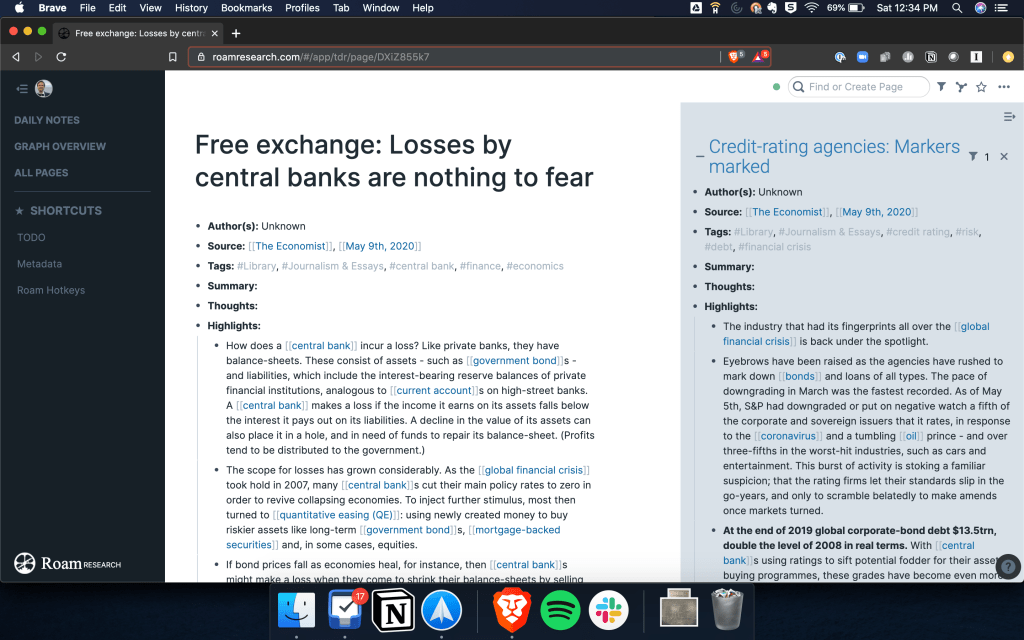
    One of Roam’s key features is its sidebar, allowing you to open up pages without losing your main page in view. In the example below I shift+click [[global financial crisis]] to get an overview of other mentions of ‘global financial crisis’ on other pages I have created.

    I can shift+click on a link in the sidebar and it will open up there as well allowing me to dive deeper into this topic. For example, I can click on [[Credit-rating agencies: Markers marked]] to open that article.

    Writing

    I think you may be getting the main idea of Roam and why it so powerful. And not only for note-taking, but also for writing. For example, this article is an adaptation of a blog post on my favorite productivity and knowledge management tools which I’ve published on the internal Tamr blog (Tamr is the company where I work). I want to reuse parts of the text from that blog and Roam makes that extremely easy, again with the help of the sidebar.

    I can either copy-paste the text or preserve the link by option+dragging (for mac) the bullet(s) into the article I am writing. The dragged text will become an active link that takes you back to the ‘source’. The linked text gets a subtle underline. To the right of the original text, you now see the number ‘1’ indicating this text has once been referenced elsewhere. Clicking that ‘1’ shows you where the text has been referenced.

    When you are writing and using multiple sources, this is a great way to maintain the connections and to help you in creating a list of references.

    What I am paying for Roam and final thoughts

    Okay, I am going to stop here for now. There are many more cool things you can do with Roam, but I’ll leave it to you to do some exploring yourself.

    One great resource that got me started is Nat Eliason’s video What’s So Great About Roam Research? He also has a great course on using Roam in case you really want to go all the way and join the Roam Cult.

    Roam is currently live in beta (there may be a waiting list), but they will soon start billing. The founder indicated pricing at $15/month, with lower pricing points for students and several other user categories.

    Roam is not cheap and more expensive than other tools like Evernote and Notion. But for me, it is totally worth it, as it allows me to capture ideas, insights, and thoughts in a networked and intuitive way and enables me to write more effectively.

    Disclosure: After first becoming a Believer and signing up for the 5-year plan in 2020, I also became an investor in Roam Research by participating in their 2021 funding round.

  • In 2015, I published a Master’s thesis titled Complementary Experience in Founding Teams and Tech-Venture Performance. The thesis was both my Duisenberg School of Finance graduation project and part of a larger study I was conducting with a team of data analysts at Deloitte Innovation and THNK School of Creative Leadership. This study became known as the Scale-up Study and got nationwide coverage. You can find the report here.

    We worked with a database of 400,000 companies and enriched the dataset allowing for more in-depth analysis. For my Thesis, I worked with a subset for which I manually collected data on the founding teams (yes this was a painful process).

    The results were not shocking, mind-boggling, or revolutionary, but confirmed existing theories.

    The key takeaways from my research

    The key takeaways on complementary experience in founding teams:

    1. In the context of founding teams, entrepreneurial experience is the most important predictor of high-growth performance of technology startups.
    2. Startups with founding teams that have a combination of academic + corporate + entrepreneurial experience are most likely to be in the top performer group.
    3. Unicorns — startups valued at $1B or more within a five-year time frame — have the highest rates of complementary experience in founding teams AND the highest ratio of gender diversity.

    The academic experience present in high-growth founding teams is typically technical, computer science and engineering being the most dominant fields.

    The key takeaways from the Scale-up study

    In the Scale-up study, we looked at other factors beyond founding teams, such as industry growth, business model design, and revenue evolution. Below are the key takeaways.

    1. Scale-ups have experienced leadership and functional depth, debunking the popular image that successful companies are founded by 20-year college drop-outs in their garage.
    2. Scale-ups and unicorns are designed for scalability, their business models allow for agile development and short and continuous iteration cycles.
    3. Scale-ups and unicorns get market timing right, either by being patient and deep industry and/or market knowledge or, well, by luck.